

In an era when innovation and adaptability are crucial, championing initiatives that align with your passions and organizational goals can lead to transformative change. You might be passionate about many things, such as introducing quantitative UX practices at your organization, making commutes more environmentally friendly, or ensuring UX has a seat at the table during product decisions. Whatever the focus, championing initiatives that align with both your passions and your organization’s goals can spark transformation across teams and culture.
Becoming a change agent is about channeling that passion into meaningful action. F. C. Lunenburg defines a change agent as “Anyone who has the skill and power to stimulate, facilitate, and coordinate the change effort.”
In this article, I will share seven principles for effectively advocating and implementing the initiatives that matter most to you. These are drawn from my experience founding and leading the Inclusive UX Group at my organization, where I learned how small ideas can grow into lasting impact. I hope these principles serve as a starting point or a set of guidelines, rather than rigid rules. Every organization has its own culture and constraints, so you should feel free to adapt these principles, add to them, or adjust the emphasis based on your specific context.
The Principles
You may already know which initiative you want to pursue and have a clear vision of the change you want to see in your organization. Or you may not feel as certain and wonder, “Where do I start?” Here’s a quick starting point for exploring your focus.
Principle 0: Make Connections Between Your Interests and the Existing Gaps in the Organization
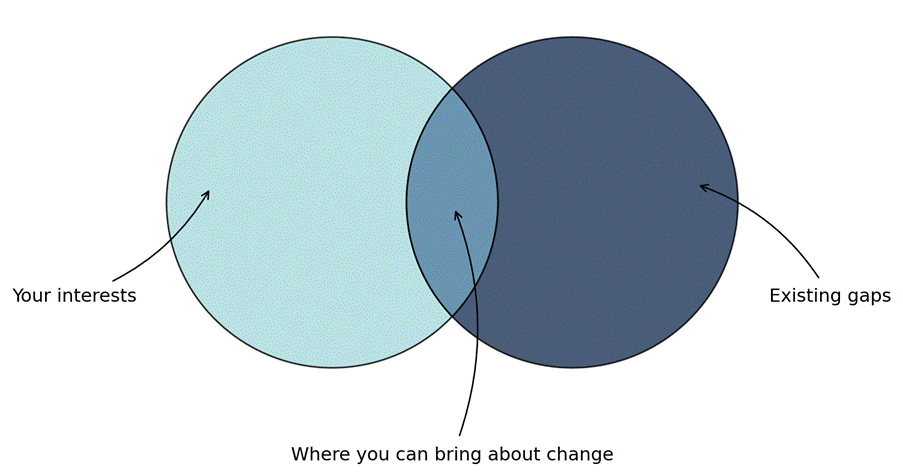
Figure 2: The overlap between your interests and the organizational gaps is where you can bring about change (generated with ChatGPT).
Start by making two simple lists. The first includes initiatives you are genuinely interested in. Do not overthink it, simply write down the areas that spark your curiosity. The second list includes opportunities for change, that is, where you see gaps in your organization that need attention.
The overlap between these two lists is often where you can have the most impact. While working in that overlap is not a strict requirement, it can give you the additional motivation to go the distance. In my experience, passion makes it easier to sustain momentum and deliver meaningful results.
Finding the point at which your interests and organizational gaps connect sets a strong foundation and ensures that your efforts are both personally fulfilling and organizationally relevant.
Principle 1: Tell Powerful Stories to Get Management Commitment
Once you know which area you want to pursue, the next milestone is convincing your management chain to support the initiative. Because everyone works with limited bandwidth, it is important to approach leadership in a clear and structured way.
Begin by identifying the people whose approval you will need to move your idea forward. Prepare a short pitch, either written or in a slide deck, that addresses a few key questions:
- What gap did you notice?
- Why is it important to address this gap now?
- Are there any statistics or evidence that illustrate the impact of this issue?
Share your proposal through existing communication channels in your organization, such as a regular team meeting, an internal newsletter, or a leadership forum.
Here are a few tips for making your case more effective:
- Speak the language of your stakeholders: Understand what appeals to them. Some may be persuaded by stories and examples, whereas others prefer quantitative data. Some may prefer a written proposal, whereas others respond better to a short presentation.
- Highlight the risks of doing nothing: While it is common advice to emphasize the benefits of your proposal, research in behavioral economics shows that people often respond more strongly to potential losses than to potential gains (Kahneman and Tversky 1979). Framing the issue in terms of what the organization might lose if no action is taken can be especially compelling.
- Ask for time to explore the problem space: You do not need to approach stakeholders with all the answers upfront. For example, if you want to propose solutions for making employee commutes to the workplace more environmentally friendly, you could start by sharing data about the impact of commuting for your local office. You could then request time to investigate the issue on a global level in more depth.
Securing buy-in early ensures that your initiative has the sponsorship and legitimacy it needs to grow beyond a personal passion project to become an organizational priority.
Principle 2: Create Awareness About the Importance of the Work
After you gain buy-in from your management, it is important to create awareness about your initiative. This helps build a community of supporters who share your interest, which amplifies the visibility of your work.
Here are some ideas to build awareness:
- Start a book club or a video club: Gather colleagues to read and discuss a book on a specific topic. If budget is a limitation, you can create a video club by curating a weekly set of short talks or tutorials and discussing them for one hour each week.
- Model and share: Demonstrate your ideas in action and share them broadly. For example, if you conducted a quantitative study, present your findings to the UX department during regular meetings. Sharing tangible results helps generate interest.
- Throw watch parties: For a low-effort option, host a watch party for a conference that streams discussions online for free. Bring colleagues together in a physical or virtual space to view and talk about sessions related to your initiative.
Small efforts like these help normalize the conversation, build grassroots support, and make your initiative part of the organizational culture.
Principle 3: Recruit People with Shared Goals
As you continue to create awareness, you will naturally cross paths with colleagues who share your interests, such as quantitative UX. This is an opportunity to join forces with like-minded people and make your ideas both practical and successful. Although it may be tempting to work on an initiative alone, it is important to remember that lasting change requires collaboration.
Here are some tips for building a strong team:
- Design a support model: Recognize that not everyone will be able to commit the same amount of time. Some colleagues may be able to devote significant effort and take ownership of resources, while others may prefer to contribute in smaller ways, such as reviewing materials. Designing a flexible support model ensures that you can engage people meaningfully, regardless of their availability.
- Seek complementary skills and lived experience: Recruit colleagues who bring both diverse skills and lived experiences. Technical expertise, research ability, communication skills, and project management are all valuable, but so are perspectives shaped by different backgrounds and experiences. This diversity strengthens decision-making and helps ensure that your initiative is more inclusive and resilient.
- Leverage networks: Team members who bring strong internal networks can be especially valuable. Their reach and influence will help amplify your initiative. (This is covered in greater detail in Principle 5.)
Building a team with shared goals not only distributes the workload, but a team strengthens the initiative through collective energy, diverse perspectives, and a wider organizational reach.
Principle 4: Prepare for Pushback
When you assemble a team, the ultimate goal is adoption of your initiative. For example, if your aim is to introduce quantitative UX across your department, you may need to lay the groundwork by creating learning resources, arranging external trainings, evaluating tools for quantitative UX, and getting budget approvals for the tools. This is a challenging task. Reaching goals like these will require talking to many people, convincing them of the value, and sometimes hearing “no” along the way. Therefore, preparing your team for pushback is essential. They need to understand that the path to change will not be easy, but it will be worth the effort.
Here are some ways to prepare for pushback:
- Anticipate questions: Senior stakeholders often have limited time. Anticipate their questions in advance so you can provide clear, confident answers when it matters most. This preparation helps your team appear aligned and well-informed.
- Leverage allies and sponsors: Identify allies and sponsors who can advocate for your initiative and open doors to discussions you may not otherwise have access to. Their support can increase your visibility and credibility.
By preparing for resistance, your team will be in the right mindset to expect challenges but push through to keep the initiative moving forward.
Principle 5: Strengthen Your Network and Influence
In the process of driving change, you will need to talk to multiple people and teams, ask for help, or request they do some work that was not on their radar. The more influence you have, and the more people know you, the easier it will be to make progress. For example, imagine you want to improve how employees commute to work across your entire organization. You may need to coordinate with the transport department, managers in different divisions, and possibly even offices in other regions. You do not need to know every person in the company, but a strong network can help you get introduced to the right people.
Julie Battilana and Tiziana Casciaro examined 68 change initiatives within the UK’s National Health Service. Their study, shared in Harvard Business Review, found that the structure of a change agent’s network was a key factor in whether an initiative succeeded.
Change agents in cohesive networks, where people already know and trust one another, were more effective at driving incremental change. Change agents in bridging networks, who connected groups that were not previously linked, were more effective at driving major change. If we apply this to the commuting example, working only with your immediate colleagues (cohesive network) may help you achieve small wins, such as arranging carpooling for your local office. However, connecting across departments and locations (bridging network) would be essential for larger, system-wide impact. This could result in establishing a shuttle or bus service across offices or introducing options such as e-bikes to support more sustainable commuting.
Like any other capability, building and leveraging networks is a skill that can be developed over time. I personally did not have this skill at all when I started working, and I still have a long way to go. If this is an area where you want to improve, you can enlist a co-chair or collaborator with a strong network to help move your initiative forward.
Principle 6: Give People the Tools to Get Started and Build Confidence
In Principle 2, we discussed creating awareness about your work, such as by organizing a book club to build quantitative UX skills. Awareness is an important foundation, but it will only take you so far. The next step to making change sustainable is equipping people with tools that help them take action and build confidence.
For example, you could create practical resources such as job aids or quick-start guides. These might include instructions on when to use specific methods and step-by-step approaches for applying them.
As you create these resources, consider the following:
- Integrate aids into existing workflows: Make resources easy to access. Avoid requiring extra steps, multiple clicks, or hidden links.
- Take feedback and iterate: Share resources early, gather feedback from users, and adjust. Iteration ensures that the tools are truly useful and relevant.
When you create opportunities for colleagues to practice, you make it easier for them to take the first step. Each successful attempt builds their confidence, helping to establish the initiative which becomes part of the organization’s regular practice.
Principle 7: Track Your Wins, Know What Success Looks Like
Leading an initiative and changing minds is a significant undertaking. Some days it may feel like you are not making enough progress, and that can be discouraging. To stay motivated and focused, I recommend keeping track of your wins, both big and small.
This serves two purposes:
- It gives you something to revisit when you feel progress is slow, reminding you of how far you have already come.
- It provides a valuable update for management and stakeholders, who will want to see how their support for your initiative is paying off.
In addition to tracking wins, it is important to be clear on what success looks like. This may evolve over time, but having a definition keeps you and your stakeholders aligned on the ultimate goal. For example, will you consider your initiative successful when 70 percent of the department is comfortable applying quantitative principles? Or when 50 percent of employees adopt more sustainable commuting practices? Develop a definition to stay focused.
Final Thoughts
I hope you use these principles as a guideline and adapt them in a way that supports your journey as a change agent. Now that I have shared approaches for how you can champion initiatives, I want to be true to the discussion in Principle 6 and give you a tool that can help you get started. Here is a simple worksheet to give you a space to brainstorm how you would lead an initiative and outline your first steps.
Resources
Lunenburg, Fred C. 2010. “Managing Change: The Role of the Change Agent.” International Journal of Management, Business, and Administration 13 (1).
Kahneman, Daniel, and Amos Tversky. 1979. “Prospect Theory: An Analysis of Decision Under Risk.” Econometrica 47 (2): 263–291.
Harley, Aurora. 2016. “Prospect Theory and Loss Aversion: How Users Make Decisions.” Nielsen Norman Group. https://www.nngroup.com/articles/prospect-theory/
Battilana, Julie, and Tiziana Casciaro. 2013. “The Network Secrets of Great Change Agents.” Harvard Business Review, July–August. https://hbr.org/2013/07/the-network-secrets-of-great-change-agents

Rajasi Desai is a Principal UX Researcher at MathWorks, focused on enhancing the user experience for technical users. She also leads the Inclusive UX Group, embedding inclusivity into the broader UX strategy. Rajasi holds a graduate degree from the University of California, Berkeley.
User Experience Magazine › Forums › Becoming a UX Change Agent: Seven Principles for Lasting Impact