

Figure 1:A suited figure, the Ghost Applicant, with their face draped in cloth and a corporate name tag (generated with ChatGPT).
Introduction
If design is about empathy and respect for users, why is hiring in our own domain so disrespectful? We say that we’re user-centric. We talk about empathy, research, and iteration. When it comes to the hiring experience for our peers, however, design leaders and hiring teams often deliver the opposite.
Fake or evergreen job postings abound with silence after candidates apply—no acknowledgement, no follow-up—or copy-paste rejection emails that could apply to anyone. Layer all that atop a tangle of Applicant Tracking System (ATS) tools, artificial intelligence filters, and micro-services like scheduling bots and résumé parsers, and we get something closer to an assembly line than a human process. It’s more than inefficient; it’s unethical, especially in industries built on the language of empathy.
For designers, it’s doubly ironic: We preach user-centeredness while treating fellow designers like disposable clicks. The intent of this article is to apply design thinking and UX methods to this broken system, not to complain, but to show how the same mindset we apply to products can improve hiring in our field.
This examination of hiring through a design-thinking lens connects directly to an idea from The Serendipity Principle (Christos, forthcoming): “What breaks reveals what wants to emerge.”
If breakdowns reveal what wants to emerge, then hiring is a perfect case study. It’s a system that’s been strained by automation, speed, and silence, which exposes how far our industry still is from its own values.
The Problem We’re Ignoring
Over time, speed and scalability became the metrics that defined good practices in hiring. The process was optimized for efficiency, not empathy, automated where it should have been human, and standardized where it needed context.
What’s left is a system that protects itself from risk but forgets the people inside it:
- Ghosting is normalized: Silence feels safer than feedback.
- Fake or evergreen roles: Vanity metrics (pipeline) outweigh respect for time.
- Opaque screening: ATS/AI filters with invisible rules erode trust.
- Vague rejections: “We went in another direction” is not useful information.
- Process sprawl: There are ten-plus tools, no single owner, and no key performance indicators for candidate care.
Recent surveys confirm these issues are widespread. According to research cited by Axios, over half of candidates report being ghosted, and a third consider even a week of silence to be ghosting (Kellogg 2024). In UX terms, that’s a broken feedback loop on an industrial scale.
If we shipped a product with this much friction and silence, we’d call it a failure. Why is hiring exempt? Here is a quick snapshot from mapping a typical flow:
- Early-application attrition ≈ 40% (form fatigue and unclear must-haves).
- Screening attrition ≈ 30% (opaque rules and keyword bias).
- Interview-stage attrition ≈ 50% (repetition and slow feedback).
- Final-stage ≈ 90% (one offer, but others get no closure).
Methodology Note: Attrition Data Sources
The attrition percentages we found are derived from qualitative research conducted between February and April 2025, specifically focused on UX and product design hiring processes in mid-sized tech companies (100-500 employees).
The research covered the following:
- Candidate interviews (n = 12): Semi-structured interviews included designers who applied for mid-level UX product-design roles within the past 12 months.
- Recruiter workflow analysis: Mapping sessions with 3 technical recruiters across 3 organizations revealed current processes and potential for improvement.
- Journey mapping synthesis: Aggregated touchpoint analysis identified emotional peaks and friction points across 7 hiring stages.
These figures represent observed patterns in design-specific hiring contexts and notably exceed broader industry benchmarks. Although general recruiting data suggests 20-30% stage-by-stage attrition with less than 1% overall conversion (CareerPlug 2025; HackerEarth 2024), design hiring involves additional complexity: Portfolio reviews, design challenges, cross-functional panel interviews, and extended deliberation cycles create compounding friction points.
The higher attrition rates we observed reflect these cumulative impacts:
- multi-tool pipeline complexity (ATS, portfolio platforms, scheduling tools, and communication channels)
- extended time-to-decision metric (averaging 6-8 weeks from the application to an offer)
- inconsistent communication protocols across hiring stages
- lack of standardized feedback mechanisms
These figures come from design research methods, qualitative interviews (n = 12), recruiter workflow analysis, and journey mapping, which are the same methods we use to understand user behavior in product design. The patterns are consistent and representative, surfaced through observation and synthesis rather than statistical sampling.
Mapping the Candidate Journey
I wanted to understand the mess in Abby Covert’s sense of the word: the tangled, often invisible systems that shape human experience (Covert 2014, 17). So, I mapped the end-to-end candidate journey for a mid-level UX product-design role in the tech sector, drawing from publicly available hiring data and qualitative research, recruiter workflow analyses, as well as first-hand candidate interviews. The result was bleak but revealed where and why both candidates and recruiters drop off.
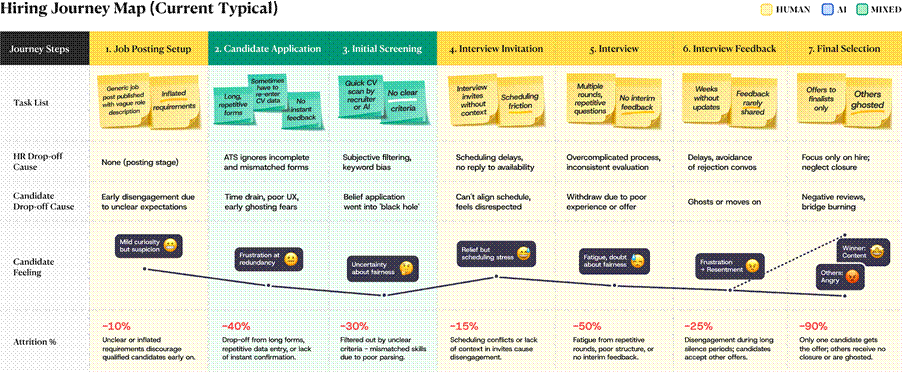
Figure 2: The current hiring journey can be presented as a horizontal journey map of a typical tech/design hiring process. Seven stages include emotional dips and red-flagged drop-off points.
The journey map represents the seven stages of hiring, including job posting setup, candidate application, initial screening, interview invitation, interview, interview feedback, and final selection. Candidate emotions dip sharply between the interview and the decision. Major warnings appear at the application, screening, interview, and interview feedback stages, marking key drop-offs where candidates experience uncertainty, delay, or lack of feedback.
The map shows this:
- Application gate: Long, repetitive forms without instant feedback lead to doubt and drop-off.
- Opaque screening: “Did a human even see this?” Anxiety spikes.
- Communication vacuum: Emotions crater between interviews and decisions.
- Late-stage silence: Finalists often hear nothing, damaging their reputation.
As I mapped the hiring journey, the emotional pattern became impossible to ignore. Candidates start with mild curiosity but quickly slide into doubt, then wonder during screening, “Am I a person or a keyword?” The tension lifts briefly when interviews are scheduled, but it returns in the long silences that follow. One participant put it simply: “If you can schedule me, you can update me.”
A quick note about assessments: Alongside interviews, almost all candidates in this research also completed a take-home assignment in an increasingly standard design challenge stage. Although this step is inside the interview phase, candidates treated it as its own chapter, complete with unclear expectations, heavy time investment, and disproportionately high stakes. Because it introduces its own structural and emotional load (assignments are often followed by vague feedback, if there’s any at all, or utter silence), this stage deserves its own dedicated breakdown, which will follow in a separate article.
By the post-interview stage, frustration replaces hope. Weeks often pass without updates, and candidates begin to assume the worst. As one wrote, “A ‘no’ in two sentences beats silence in two weeks.”
These voices mirror what the map itself shows: Emotional dips align precisely with the system’s points of opacity and delay. It’s a feedback loop that hurts trust on both sides.
Principles for a Better System
What became clear from the mapping exercise was that the pain points weren’t random but rather followed a consistent pattern. At every stage, breakdowns stemmed from the same root causes: unclear expectations, missing feedback, and automation without empathy. These themes appeared in both candidate interviews and the journey map’s emotional dips, where silence, opacity, and repetition led to the steepest drop-offs.
I translated these findings into design language and surfaced five core principles aimed at making hiring as intentional and human as the products we design.
- Clarity before commitment:
State must-haves upfront with transparent knockout checks. Ambiguity at the job-posting stage wastes time on both sides. A Human Capital Express 2024 analysis found that organizations with precisely written job descriptions fill roles 50% faster and see a 33% increase in applicant quality (Human Capital Express, 2024). Treat job posts like interface design: Every extra input or vague label adds friction before a user clicks Apply.
- Feedback at every branch:
No dead ends; every “no” gets a reason and a next step. According to Greenhouse’s 2024 Candidate Experience Survey, 52% of job seekers say that silence after interviews is the most frustrating part of hiring (King 2024). Even brief, pre-approved templates close emotional loops and preserve trust. In UX terms, feedback isn’t optional; it’s part of the interaction model. - Human where it matters:
Automate repetition; keep real conversations human. Scheduling, confirmations, and rejections can be automated, but evaluation and closure should still involve people. Research shows that structured interviews combined with human-led decision-making improve fairness and candidate satisfaction (Lyons 2024). Empathy doesn’t slow the system; it sustains it. - Measure the humanity:
Track the ghost rate and time-to-response metric with the same rigor as time-to-fill. Research shows that organizations with superior candidate experiences achieve a 38% higher Net Promoter Score® (NPS) in the research-and-attract stage compared to average organizations (Talent Trends 2024). What you measure signals what you value; if you don’t track humanity, the system forgets it. - Legally safe specificity:
Use objective, role-related reasons; no vague culture fit euphemisms. The EEOC’s 2024 guidance on AI and employment decisions warns that unstructured evaluation criteria can lead to bias or disparate impact (U.S. Equal Employment Opportunity Commission 2024). Each decision should be explainable in clear, job-related terms.
If you can’t explain a rejection in one job-related sentence, maybe you shouldn’t be rejecting. Every unexplained “no” isn’t just poor communication; it’s an ethical blind spot that values convenience over clarity. In design and in hiring alike, opacity is where bias hides.
The Design Solution
I applied these five principles to reframe the hiring flow into something faster, fairer, and more transparent for both candidates and employers. The goal wasn’t to invent a new process but to redesign existing stages around clarity and feedback to make each touchpoint more intentional.
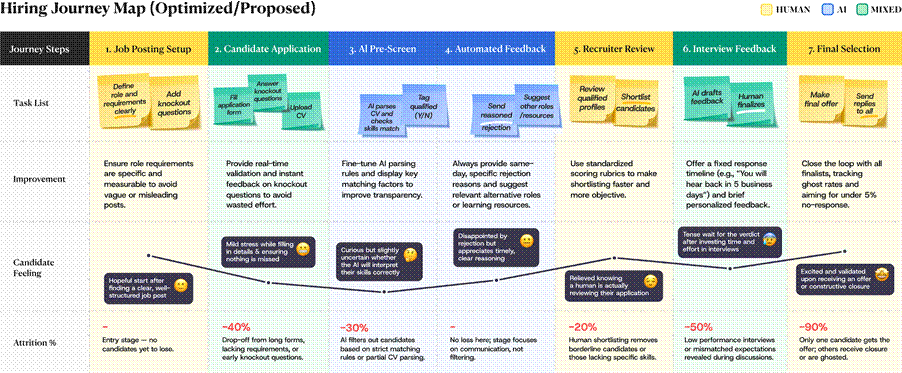
Figure 3: Proposed hiring journey showing a horizontal journey map of the redesigned process with clear must-haves, instant knockout validation, explainable tags, structured interviews, and humane closure for all candidates (created with Figma™).
The redesigned journey map represents the seven hiring stages including job posting, application, AI pre-screen, automated feedback, recruiter review (and interview), decision (and interview feedback), and final selection (and closure). The optimized, proposed map supports a smoother emotional progression with fewer drop-offs. Improvements appear at the posting, screening, feedback, and final decision stages, in which automation provides speed and humans provide empathy.
Before and After at a Glance
Each of the following changes maps a design principle to a real moment in the hiring flow. These are small, but high-leverage shifts that translate abstract ideas into practical, humane interventions.
- Posting: From vague to concrete must-haves (years of experience, certifications, time zone, and work authorization), clarity prevents wasted applications and supports faster self-screening (Principle 1 – Clarity before commitment).
- Apply: Long and silent become short, instant validation on knockout questions. Borrowing from UX testing, immediate feedback lowers anxiety and improves completion rates (Principle 2 – Feedback at every branch).
- Screen: Opaque responses become explainable tags (“Missing PCI-DSS; Kotlin less than 3 years”). Explainability builds trust and lets recruiters defend consistency in their decisions (Principle 5 – Legally safe specificity).
- Feedback: Generic messages become same-day reasoned messages with role suggestions. This converts silence into signals and strengthens the long-term candidate perception (Principle 4 – Measure the humanity).
- Shortlist: Ad hoc responses become scorecards and reason codes. This creates a shared decision language and reduces bias drift between interviewers (Principle 3 – Human where it matters).
- Interviews: From repetitive and drifting to structured loops with response service-level agreements (within 5 business days). Consistency and timing show respect and improve fairness (Principles 3 and 4).
- Final: Ghosting becomes closure for all finalists, including the candidate receiving the offer. A process that ends with clarity, even in rejection, leaves every participant informed rather than ignored (Principles 2 and 4).
Together, these adjustments reframe hiring as a designed experience rather than an administrative sequence. Each stage reduces uncertainty and bias while improving speed and transparency.
Research supports this shift. Google™ re:Work found that structured interviews outperform ad hoc interviews in both predictive validity and candidate fairness (Google n.d.), and Harvard Business Review reports that transparent, repeatable loops reduce bias and accelerate decision-making (Lyons 2024). The redesign borrows from UX’s own evidence-based mindset: define, test, iterate, and measure what improves the human experience.
Copy You Can Steal: Sample Templates
Designing better hiring experiences isn’t only about structure; it’s also about language. The words we use shape how candidates feel and interpret fairness. Below are message templates that apply the same principles from the redesigned journey: clarity, feedback, and respect at every step.
Auto-stop (fails knockout): Principle 1 – Clarity before commitment“Thanks for your interest in [role]. This role requires [requirement], which isn’t currently in your application. Here are roles that may fit now: [links]. When this changes, we’d love to hear from you again.”
Not qualified (objective, same-day): Principles 2 and 5 – Feedback and specificity
“We’re moving forward with applicants showing [skill/depth/context] (e.g., [X @ Y scale]). This wasn’t evident in your materials. Suggested resources: [link].”
Near-miss (talent pool): Principle 4 – Measure the humanity“You’re close. We prioritized candidates with [specific edge]. With [gap], you’ll be competitive—please keep in touch.”
Post-interview rejection (humane closure): Principles 3 and 4 – Human where it matters and measure the humanity.
“Thank you for your time. We chose a candidate with [distinct experience]. Strengths we saw: [2 bullets]. If [Z] becomes part of your profile, we’d be keen to revisit.”
Reason-code starter set: Use these to anchor feedback in objective, role-based criteria:
- missing [certification]/[domain depth]/[years in core tech]
- scope mismatch (startup versus enterprise)
- availability or time zone overlap
- role requires on-site [location]
- security/clearance requirement unmet
Process guardrails: Every message is part of the UX. Define operational standards to protect consistency and reduce silence creep:
- Service-level agreements: Automated feedback same day; interviewed candidates within 5 business days.
- Dashboard: Track the ghost rate (goal < 5%), time-to-first-response, and percentage with reasoned feedback.
- Review cadence: Sample 20 messages weekly for tone, bias, and false negatives.
Consistency in communication also improves efficiency. Research on time-to-fill versus time-to-hire shows that faster, clearer responses improve candidate sentiment, and they reduce mid-process drop-off and shorten hiring cycles (iCIMS and Oliver n.d.).

Figure 4: A rejection email that says nothing isn’t a response; it’s a system protecting itself from feedback (generated with ChatGPT).
Figure 4 illustrates that, although a typical, generic human resources (HR) rejection answer might appear nice, it is not an answer. What it reveals is where design failed.
Designing for humanity in hiring doesn’t stop at good intentions; it changes the numbers, too. Clearer communication shortens time-to-hire, structured feedback reduces attrition, and respectful closure improves brand trust. These changes have a tangible impact when design principles meet recruiting reality.
The Impact You Can Expect
The design changes don’t just feel better, but they perform better. When friction is absent and structured feedback loops are present, the process becomes faster, fairer, and more measurable. The before-and-after data show how candidate experience and operational efficiency improve when design principles are applied to hiring.
Candidate time: Previously, candidates spent 30-60 minutes completing forms only to discover late-stage deal-breakers. Now, clear knockout questions reveal alignment within 60 seconds. This saves time for both sides and mirrors the instant feedback users expect from digital products.
Feedback: Previously, silence or generic rejection emails created frustration and uncertainty. Now, candidates receive a specific, role-related reason that is supported by templates and pre-approved phrasing. According to JobScore’s research, 70% of rejected candidates say that receiving clear, detailed feedback leaves them with a positive impression of the company, and finalists who receive it are 30-50% more likely to refer others (Dewar 2025). Feedback isn’t just a courtesy; it’s reputation design.
Recruiter workload: Previously, recruiters drowned in volume, scanning hundreds of unqualified profiles. Now, automated validation and clearer criteria surface only relevant applicants. This reduces manual screening time and allows recruiters to focus on genuine fits.
Legal risk: Earlier, ad hoc phrasing risked bias or inconsistency. Now, pre-approved reason codes and standardized language ensure compliant, job-related communication that is aligned with EEOC hiring guidelines.
Brand: Previously, the perception was simple: “They ghost.” After adopting explicit communication standards and consistent follow-up, organizations begin to earn reputations for fairness and respect. Transparency directly strengthens employer trust. Research shows that candidates are significantly more likely to engage with companies that communicate clearly about process and timelines (Fasthire 2024). In other words, feedback isn’t just ethical; it’s brand equity.
Target KPIs: Ghost rate is less than 5%. Time-to-response is within 2 business days. Candidate NPS improves by 20 points. These metrics quantify humanity in hiring, showing how responsiveness and closure correlate with trust and brand health. As SHRM highlights, communication is the key lever for both talent retention and pipeline growth (SHRM 2025a).
How to measure fast: Log every automated message and reason code in your ATS. Review a weekly 20-sample set for tone, bias, and false negatives. Publish your KPIs internally because culture follows visibility.
From Glitch to Practice
Ghosting is a glitch in the system; that is, a symptom of misaligned incentives such as speed over clarity and risk-avoidance over respect. But glitches are also signals. When we pay attention to them, they show us where the system wants to evolve.
When we measure a glitch and design around it, we turn chaos into signals. That’s the heart of The Serendipity Principle: “What breaks reveals what wants to emerge.” In this case, it’s a hiring system that’s fast, fair, and explicit. Breakdowns don’t destroy systems; they teach them to adapt.
Takeaways
The ghost rate is a UX metric. Track it as seriously as the time-to-fill metric. Feedback loops are design features, not HR niceties. Clarity, speed, and closure are forms of respect, and respect scales trust.
Before You Go
What if we measured the ghost rate as closely as the time-to-fill metric? What if every candidate, even the ones who heard “no,” left thinking, “They respected my time.”
That’s not just better hiring; that’s better design. When we build for transparency and empathy, the system itself becomes self-correcting. Each feedback loop we close makes the next one easier to manage. Each small act of respect compounds into a cultural signal. In the end, serendipity isn’t luck. It’s what happens when we design for what wants to emerge.
A Final Note About Assignments
I’ve intentionally kept the take-home task stage out of the core analysis in this article because it warrants its own focused article. The take-home task stage is where candidates often contribute the most work and, ironically, receive the least communication. My next article will dive deeper into how assignments are used, misused, and how they, too, can be redesigned through a UX lens.
Resources
Christodoulopoulos, Chris. Forthcoming. The Serendipity Principle: Designing Systems That Learn from Chaos. https://moodswings.gr/.
Covert, Abby. 2014. How to Make Sense of Any Mess. CreateSpace Independent Publishing. https://abbycovert.com/make-sense/.
Dewar, Jeff. 2025. “Candidate Experience Statistics You Must Know in 2025.” JobScore, August 18. https://www.jobscore.com/articles/candidate-experience-statistics/.
Fasthire. 2024. “10 Data-Driven Ways to Boost Transparency in Your Recruitment Metrics for Enhanced Candidate Trust.” Fasthire Blog, December 14. https://fasthire.co/blog/10-data-driven-ways-to-boost-transparency-in-your-recruitment-metrics-for-enhanced-candidate-trust.
Google. n.d. “Use Structured Interviewing.” Google re:Work. https://rework.withgoogle.com/intl/en/guides/hiring-use-structured-interviewing.
HackerEarth, and N. V. Chadaga. 2024. “Benchmark Metrics to Improve Your Recruiting Funnel.” HackerEarth Blog, December 17. https://www.hackerearth.com/blog/benchmark-metrics-to-improve-your-recruiting-funnel.
Human Capital Express. 2024. “Unlocking the Power of Effective Job Descriptions for Better Hiring.” LinkedIn, April 16. https://www.linkedin.com/pulse/unlocking-power-effective-job-descriptions-better-mr0vc/.
Kellogg, Heather. 2024. “Ghostbusters! How to Keep Up with Candidate Communication Expectations.” Criteria, April 24. https://www.criteriacorp.com/blog/ghostbusters-how-keep-candidate-communication-expectations.
King, Hope. 2024. “How Greenhouse Is Taking On Job Ghosting.” Axios, September 24. https://www.axios.com/2024/09/24/greenhouse-job-ghosting-hiring-rejection-email.
Lyons, Matthew. 2024. “Choosing Between a Structured or Conversational Interview.” Harvard Business Review, June 25. https://hbr.org/2024/06/choosing-between-a-structured-or-conversational-interview.
Palmeri Farris, Stephanie. 2025. 2025 Recruiting Metrics Report. CareerPlug. https://www.careerplug.com/recruiting-metrics-and-kpis/.
Society for Human Resource Management. 2024. 2024 Talent Trends Report. SHRM. https://www.shrm.org/topics-tools/research/2024-talent-trends-report.
Society for Human Resource Management. 2025a. 2025 Talent Trends. SHRM, February. https://www.shrm.org/topics-tools/research/2025-talent-trends.
Society for Human Resource Management. 2025b. “Candidate ‘Ghosting’ and Employer Competition Are Fueling Talent Shortages, New SHRM Research Finds.” Press release, July 25. https://www.shrm.org/about/press-room/candidate–ghosting–and-employer-competition-are-fueling-talent.
U.S. Equal Employment Opportunity Commission. 2024. What Is the EEOC’s Role in AI? Washington, DC: U.S. Equal Employment Opportunity Commission. April 29. https://www.eeoc.gov/sites/default/files/2024-04/20240429_What%20is%20the%20EEOCs%20role%20in%20AI.pdf.
More Reading
Cagan, Marty. 2020. Empowered: Ordinary People, Extraordinary Products. SVPG. https://www.svpg.com/books/empowered.
Duke, Annie. 2018. Thinking in Bets: Making Smarter Decisions When You Don’t Have All the Facts. Portfolio. https://www.goodreads.com/book/show/35957157-thinking-in-bets.

Christos Christodoulopoulos is a senior product designer, strategist, and director who designs systems for unpredictability. His work explores how teams, products, and organizations can stop fighting disruption and start learning from it. He has never finished a five-year plan. He has improvised through a hundred pivots.
User Experience Magazine › Forums › Stop Ghosting Candidates: How Design Thinking Can Fix Hiring