
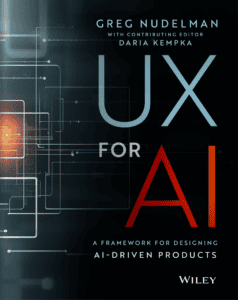
A review of
UX for AI: A Framework for Designing AI-Driven Products
Wiley
352 pages, 21 chapters
About this book
By Greg Nudelman
A good reference for Methods/Case-Studies
Primary audience: Researchers, designers, and technical roles who have some experience with the topic
Writing style: Humorous/Light and Matter-of-fact
Text density: Equal parts text and images
Learn more about our book review guidelines
UX for AI: A Framework for Designing AI-Driven Products is a book of its time from Greg Nudelman, a thought leader with a proven track record of shaping and crafting AI-driven products in the wild. Equal parts strategy guide, workbook, and reality check, the book packs a surprising amount of value into its pages.
The book opens with concise chapters on what not to do when designing AI-driven products—hard-won lessons from the author’s years working with designers, engineers, stakeholders, and the business side of product development, where AI was sometimes forced into illogical workflows or products without clear goals or business value. Nudelman highlights the most common challenges teams face and explains how to tackle the challenges in practical, detailed terms, grounding each lesson in real-world examples and case studies.
Each chapter concludes with exercises that you can complete on your own or with your team, which I found incredibly helpful and almost reassuring in a world in which AI can make tried-and-true design and research practices feel like they’re being dropped into a new Wild West. The book even takes familiar concepts—storyboarding, design best practices, and core UX principles—and updates them for a world that now includes AI. The approach is especially valuable because it meets designers and researchers where they are, rather than overwhelming them with overly technical, vague concepts that are difficult to translate into practice.
Amid this practicality, the author offers several genuine lightbulb moments. For example, how should we measure the success of AI? What if accuracy and precision aren’t the success metrics we assume them to be? He also digs into AI models, exploring the different interaction patterns they create, and how designers should think about designing around, for, or with them. These are complex problems that are still relatively new and require us to expand the way we approach product design.
The book encourages designers to take a broader perspective and think like strategists, empowering them to challenge stakeholders on whether AI belongs in a product in the first place by asking what specific goals the AI is trying to achieve and what business value it will deliver. At the same time, the book reminds us that, amid today’s AI hype, our primary responsibility remains the same: championing users. Even with AI, users’ needs, motivations, and reasons for engaging with a product or service aren’t going away.
One of the book’s strengths is that it doesn’t just speak to designers or researchers—it speaks to both. Although there are sections tailored to each discipline, I would encourage readers not to skip the chapters that seem outside their lane. Designers will benefit from understanding how researchers can help evaluate AI products, and researchers will gain a deeper appreciation for the design challenges AI introduces. At a time when our roles are evolving so quickly, having a shared understanding of the opportunities, constraints, and responsibilities of designing AI-powered experiences can only make us better collaborators and help us to create better products.
As a researcher, the sections that resonated most with me were those that explored the future of our field and offered a framework for testing AI-driven products. The book includes real advice, practical frameworks, and concrete techniques that can help researchers and designers adapt during this transformative moment, perhaps becoming even more valuable than before.
During a time of change and uncertainty for many designers and researchers, it’s a focused and weighty charge—one that reminds us not only that our work still matters, but perhaps that it matters now more than ever. It reminds us that our role is to understand AI, think strategically about where it belongs, and champion our users’ needs to create AI-powered products that deliver real value.
“AI is just too important to leave it to data scientists,” Nudelman argues. “Pure data science metrics like accuracy, precision, and recall alone don’t create viable real-world solutions. Every real-world AI solution should be tempered by a deeper understanding of both the business and human impact it creates. AI is indisputably our collective future—nothing can change that. Understanding how to use this incredible tool for the benefit of humankind and ensuring people in charge do the right thing for humanity and the planet is part of your job as a UX designer.”

Claire Menegus is a user researcher and team leader who is passionate about translating human insights into better experiences and better business decisions. At New York University’s NYU Usability Lab, she focuses on how user experience and a deeper understanding of people can improve teaching and learning, shape organizational strategy, and guide the thoughtful adoption of AI and other emerging technologies.
User Experience Magazine › Forums › Where Strategy Meets Practice for Designing AI-Driven Products (Book Review)